
Boardoza VL53L7CX-2 Time-of-Flight Breakout Board
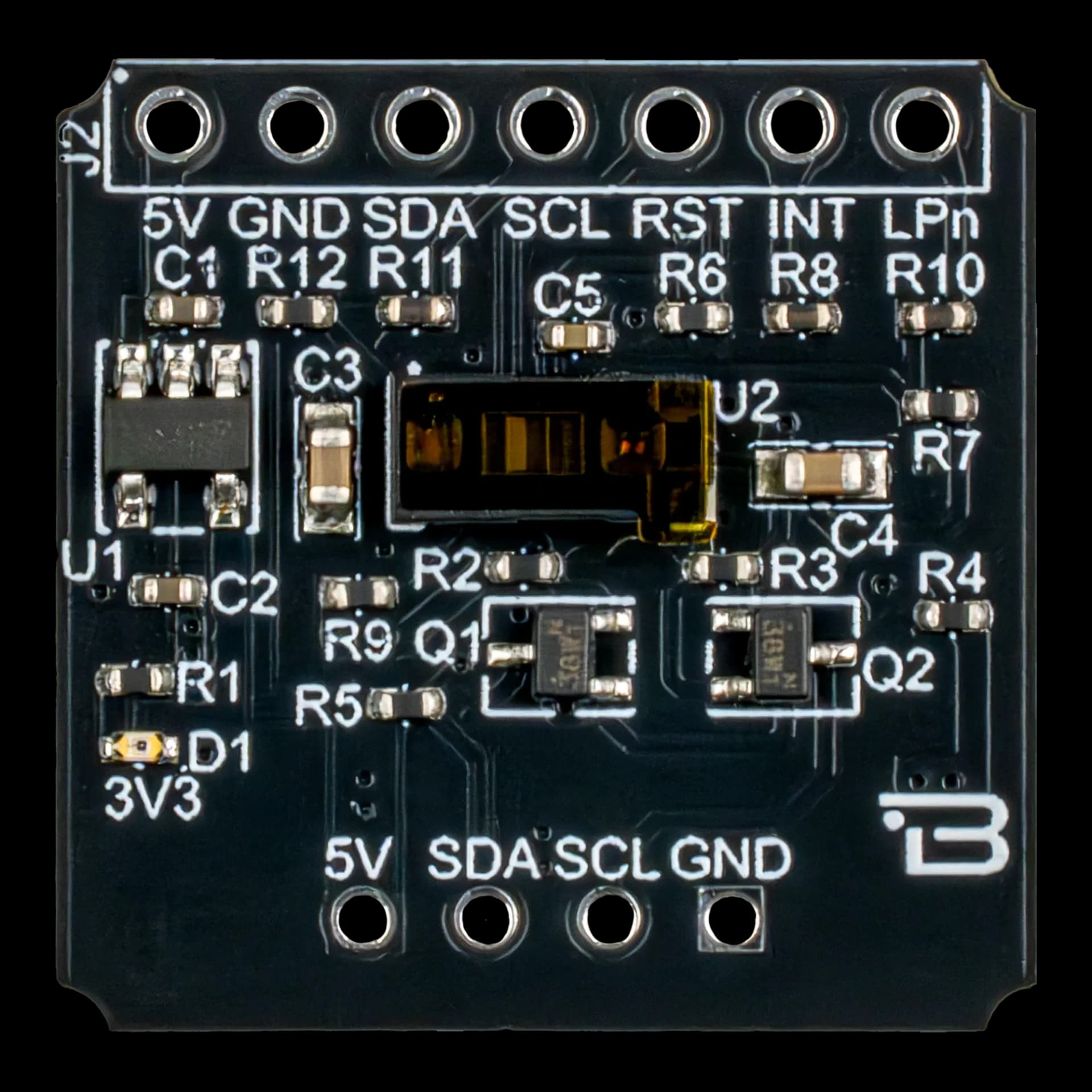
The Boardoza VL53L7CX-2 Time-of-Flight Breakout Board is a compact distance-sensing solution built around the STMicroelectronics VL53L7CX multizone Time-of-Flight (ToF) sensor. Designed for systems powered from a 3.3 V to 5 V supply, the board integrates an onboard LDO regulator and bidirectional I²C level shifters, enabling safe I²C communication with both 3.3 V and 5 V microcontroller systems.
With configurable 4×4 or 8×8 multizone ranging, an ultra-wide 90° diagonal field of view, and support for control functions such as interrupt-based operation, communication enable control, and I²C interface reset through the INT, LPn, and RST pins, the board is ideal for robotics, obstacle detection, occupancy sensing, gesture recognition, smart appliances, industrial automation, and other embedded applications that require accurate distance measurement in a compact form factor. Its dual-connector layout also allows multiple boards to be connected in a cascaded configuration, making it easier to operate more than one VL53L7CX board on the same I²C bus.
Where to buy?

Key Features
- Multizone Distance Sensing: Supports both 4×4 and 8×8 ranging configurations, providing up to 64 independent measurement zones.
- Ultra-Wide Field of View: Provides a 60° × 60° square detection FoV with a 90° diagonal field of view.
- 3.3V–5V Power and I²C Compatible: Supports 3.3V to 5V supply input and includes bidirectional level shifters on the SDA and SCL lines for 3.3V–5V-compatible I²C communication.
- 3.3V Control Signals: RST, INT, and LPn pins operate at 3.3V logic level and should not be driven with 5V signals.
- Built-In Voltage Regulation: The onboard LDO provides the required operating voltage for the sensor across the supported 3.3V to 5V input range.
- Eye-Safe Operation: Integrated Class 1 invisible 940nm VCSEL (Vertical-Cavity Surface-Emitting Laser) emitter is safe for the eyes and enables safe operation in consumer and industrial products.
- Multitarget Detection: Capable of detecting and measuring multiple targets within each ranging zone.
- Autonomous Low-Power Mode: Supports autonomous operation with programmable interrupt thresholds for host wake-up applications.
- Power Status Indicator: Integrated LED provides visual confirmation of power availability.
Technical Specifications
- Sensor Model
- VL53L7CX-2
- Manufacturer
- Boardoza
- Manufacturer IC
- STMicroelectronics
- Functions
- Multizone Time-of-Flight Distance Sensor
- Supply Voltage
- 3.3V ~ 5V
- Internal Operating Voltage
- 3.3V (generated via onboard LDO regulator)
- Communication Interface
- I²C
- I²C Address
- 0x52 (8-bit address)
- Maximum I²C Speed
- 1 Mbit/s
- I²C Logic Level
- 3.3V and 5V Compatible (SDA/SCL via bidirectional level shifters)
- Control Signal Levels
- 3.3V (RST, INT, LPn)
- Ranging Zones
- 4 × 4 or 8 × 8, up to 64 zones
- Maximum Sample Rate
- Up to 60Hz
- Measurement Range
- 2cm to 350cm per zone
- Emitter Type
- 940nm invisible VCSEL (Vertical-Cavity Surface-Emitting Laser)
- Safety Classification
- Class 1 Eye-Safe
- Detector Type
- SPAD (Single Photon Avalanche Diode) receiving array
- Field of View
- 60° × 60° detection FoV, 90° diagonal
- Operating Temperature
- -30°C to +85°C
- Board Dimensions
- 20mm × 20mm
Board Pinout
( J1 ) Power & I²C Connector
| Pin Number | Pin Name | Description |
|---|---|---|
| 1 | GND | Ground |
| 2 | SCL | I²C Serial Clock |
| 3 | SDA | I²C Serial Data |
| 4 | 5V | Positive Power Supply |
( J2 ) Power, I²C & Control Connector
| Pin Number | Pin Name | Description |
|---|---|---|
| 1 | 5V | Positive Power Supply |
| 2 | GND | Ground |
| 3 | SDA | I²C Serial Data |
| 4 | SCL | I²C Serial Clock |
| 5 | RST | I²C interface reset input, active high. Toggle from Low to High and back to Low to reset the I²C target interface only. |
| 6 | INT | Interrupt output. Used to notify the host when ranging data or threshold events are available. |
| 7 | LPn | Communication enable input. Pulled up to 3.3V for normal operation; drive Low to disable I²C communication. |
Datasheet
Download (PDF)Support
For technical questions, documentation and issue reports, use the GitHub repository or write to us directly.