
Boardoza TPT1044Q CAN FD Transceiver Breakout Board
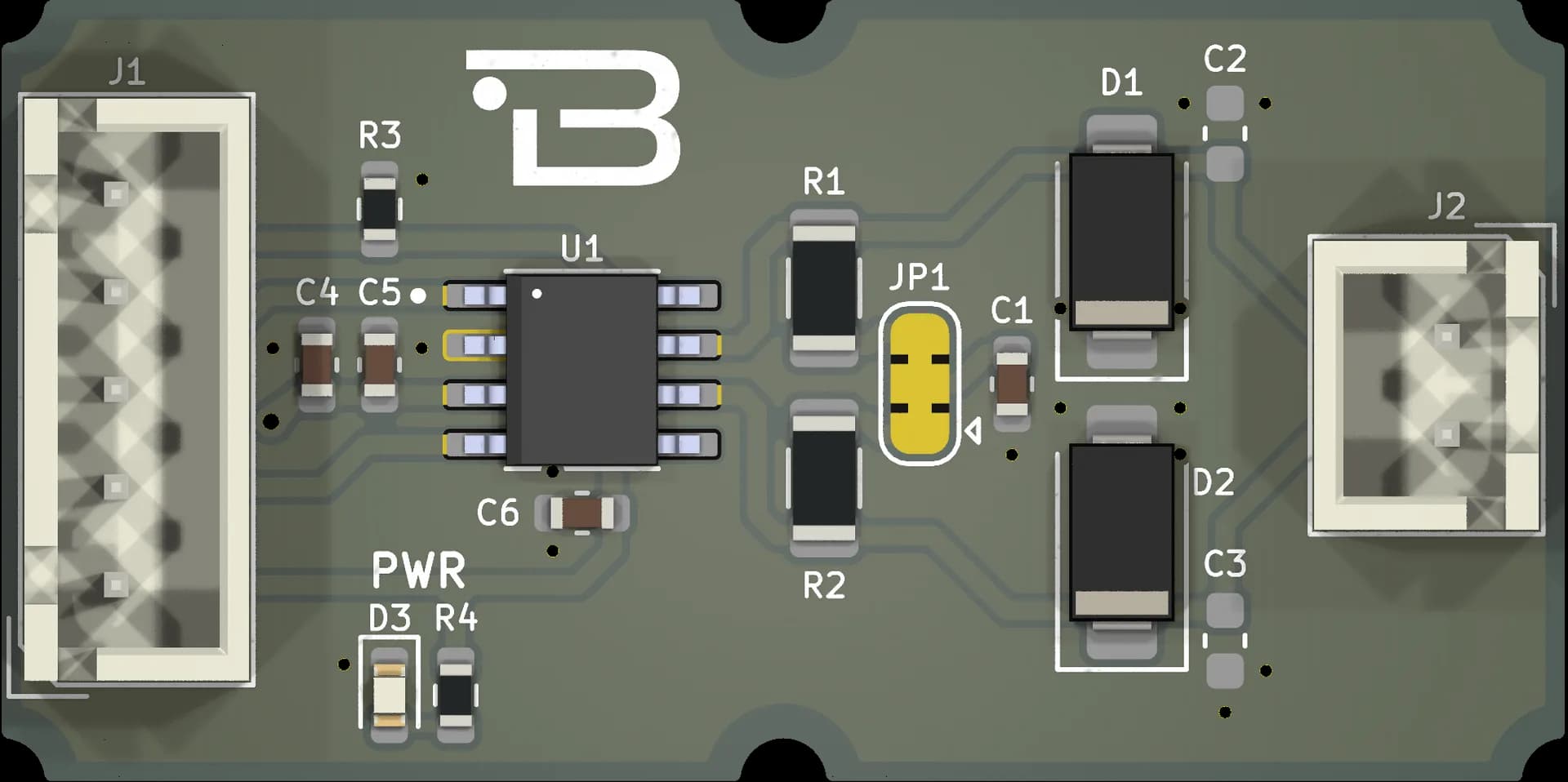
The TPT1044Q-Based CAN Transceiver Board is designed to provide reliable and high-performance CAN bus communication between microcontroller systems and CAN networks. With the integrated TPT1044Q transceiver, the board supports high-speed CAN communication while offering robust protection features suitable for industrial environments.
The board designed to be used in CAN FD networks up to 5 Mbps with enhanced timing margin and higher. CAN FD (Flexible Data-rate) is an advanced CAN protocol that extends the payload size from 8 bytes in Classical CAN up to 64 bytes, and enables higher data rates during the data phase (up to several Mbps) by using separate arbitration and data phase bit rates, resulting in faster and more efficient communication.
The board can be easily controlled via TXD, RXD, and STB (Standby) pins, enabling flexible operation and low-power standby mode. Integrated TVS diodes on CANH and CANL lines ensure enhanced protection against ESD and transient events.
Decoupling capacitors on the power lines provide stable operation, while optional termination and filtering components allow adaptability for various application requirements.
This board is an ideal solution for automotive systems, industrial automation, motor control applications, and embedded communication systems.
Key Features
- TPT1044Q CAN transceiver based design
- High-speed CAN communication support
- TXD / RXD interface for MCU integration
- STB (Standby) pin for low power operation
- CANH / CANL differential bus output
- ESD and surge protection with TVS diodes
- Optional termination and filtering components (design flexibility)
- Compact and easy-to-integrate PCB design
- Suitable for automotive and industrial applications
Technical Specifications
- Item
- B-TPT1044Q-BRK
- Input Voltage
- 4.5V to 5.5V
- Functions
- High-Speed CAN FD Transceiver
- Operating Temperature
- -40 to +125°C
- Board Dimensions
- 40mm x 20mm
Support
For technical questions, documentation and issue reports, use the GitHub repository or write to us directly.