
Boardoza TPS563203 5V Regulator Module
The Boardoza TPS563203 5V Regulator Module is a compact and efficient DC-DC buck converter designed to provide a stable 5 V output from a wide 7 V to 17 V DC input range. Built around the Texas Instruments TPS563203 synchronous buck regulator, the module delivers high efficiency and low quiescent current. It is ideal for powering microcontrollers, sensors, communication modules, and embedded systems that require a reliable 5 V supply from higher-voltage sources such as adapters, batteries, or industrial power rails. Its compact form factor and robust thermal performance make it suitable for both prototyping and production applications.
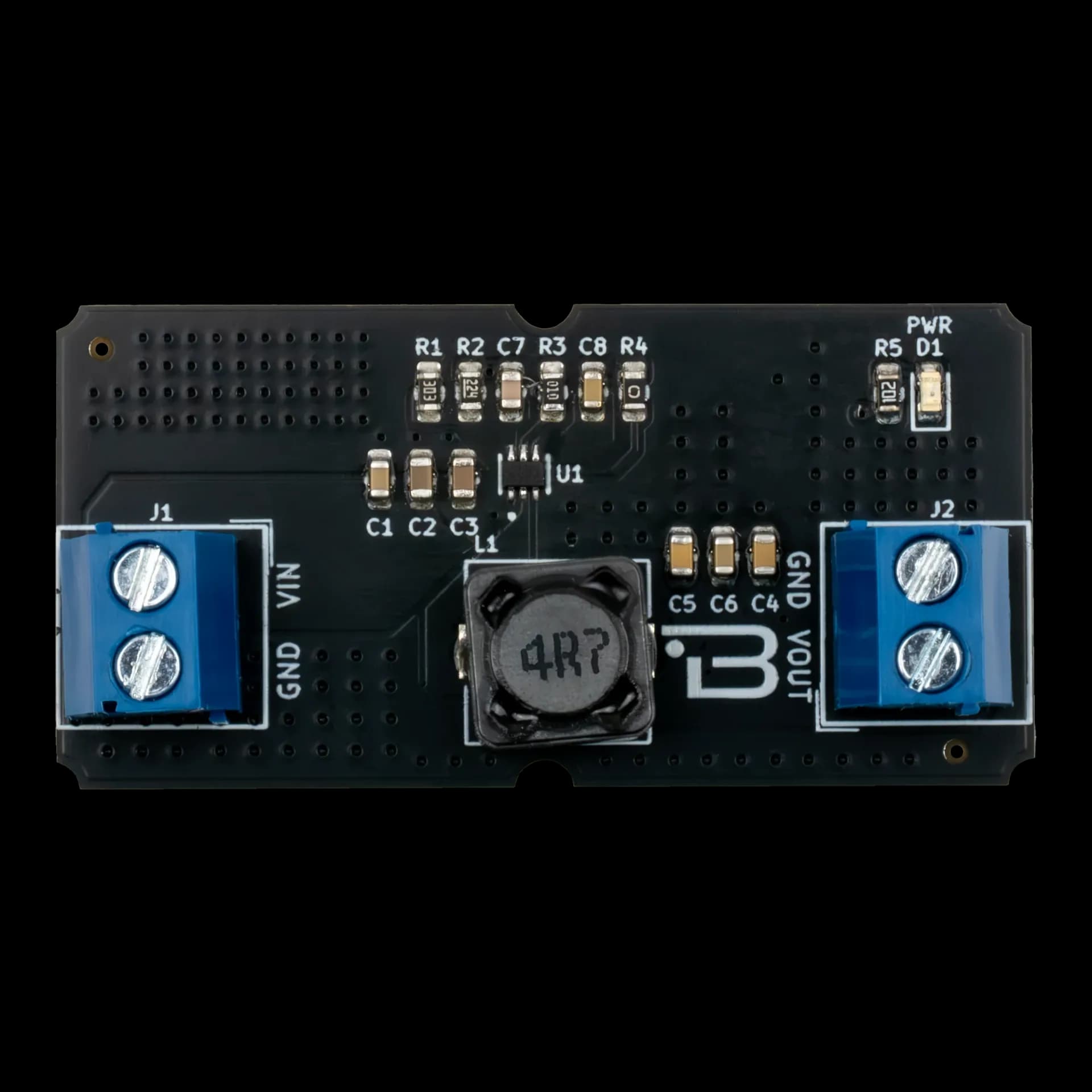
Key Features
- Wide Input Voltage Range: Supports 7V to 17V DC input for flexible power sources.
- Stable 5V Output: Provides a fixed and regulated 5V DC output suitable for logic and embedded systems.
- High Output Current Capability: Delivers up to 2A continuous output current.
- High Efficiency Buck Topology: Synchronous step-down conversion for reduced power loss.
- Low Quiescent Current: Optimized for power-efficient designs with minimal standby consumption.
- Integrated Soft-Start: Ensures controlled startup to protect connected loads.
Technical Specifications
- Model
- TPS563203 5V
- Manufacturer
- Boardoza
- Manufacturer IC
- Texas Instruments
- Regulator Type
- DC-DC Buck (Step-Down) Converter
- Input Voltage
- 7V – 17V DC
- Output Voltage
- 5V DC
- Output Current
- Up to 2A
- Switching Frequency
- 600 kHz
- Quiescent Current
- 110 µA (typ.)
- Soft-Start Time
- 1.4 ms (fixed)
- Reference Voltage Accuracy
- ±1.5% (25°C), ±2% (–40°C to +125°C)
- Operating Temperature
- –40°C to +125°C
- Board Dimensions
- 20 mm × 40 mm
Board Pinout
( J1 ) Input Connector
| Pin Number | Pin Name | Description |
|---|---|---|
| 1 | VIN | DC Input Voltage (7V – 17V) |
| 2 | GND | Ground |
( J2 ) Output Connector
| Pin Number | Pin Name | Description |
|---|---|---|
| 1 | VOUT | Regulated +5V Output |
| 2 | GND | Ground |
Datasheet
Download (PDF)Support
For technical questions, documentation and issue reports, use the GitHub repository or write to us directly.