
Boardoza NE555 Adjustable PWM Dimmer Breakout Board
This board is an adjustable PWM (Pulse Width Modulation) control board designed to generate a PWM signal using an NE555 timer IC and apply this signal to the output through a PMOS power MOSFET.
The board is designed to operate with a 5–16 V DC supply voltage. The PWM duty cycle can be adjusted using the RV1 potentiometer. Diodes D1 and D2 provide separate charging and discharging paths for the timing capacitor, allowing independent adjustment of the PWM duty cycle.
The PWM signal generated by the NE555 controls the gate terminal of the Q1 PMOS power MOSFET. As a result, the supply voltage is switched to the output according to the PWM signal.
The primary purpose of the board is to provide PWM-based power control for DC loads. By adjusting the PWM duty cycle, the average power delivered to the load can be controlled without continuously regulating the supply voltage.
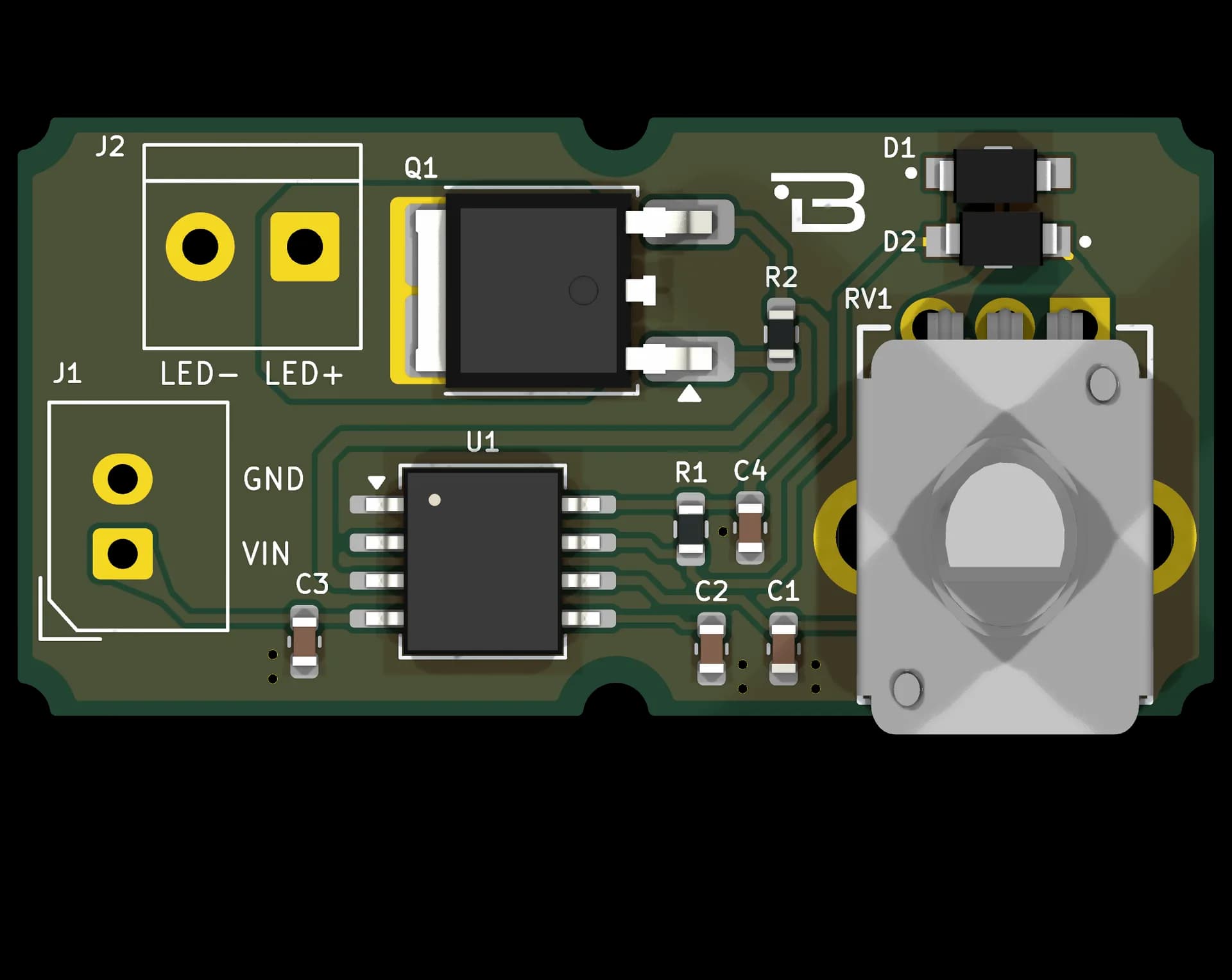
Key Features
- Wide Supply Voltage Range: 5–16 V DC
- NE555-Based PWM Generation: Reliable and adjustable PWM signal generation
- Adjustable Duty Cycle: PWM duty cycle can be adjusted using the RV1 potentiometer
- PMOS Power Switching: High-side switching using a PMOS power MOSFET
- Independent Charge/Discharge Paths: D1 and D2 provide separate charging and discharging paths for precise duty-cycle adjustment
- PWM-Based Power Control: Enables efficient power control of DC loads by varying the PWM duty cycle
- LED Load Output: Dedicated LED+ / LED− terminals for connecting LED loads
- High-Side PWM Control: Switches the positive supply to the load; the load return connects to GND
- Compact and Simple Design: Designed for easy integration into DC load control applications
Technical Specifications
- Item
- B-555 DIMMER-BRK
- Input Voltage
- (5 V to 16 V)
- Functions
- The board provides adjustable PWM-based power control for DC loads.
- Output Current
- current up to 10A
- Operating Temperature
- 0°C / +70°C
- Board Dimensions
- 20x40mm
Support
For technical questions, documentation and issue reports, use the GitHub repository or write to us directly.