
Boardoza E22-400M30S 410–493 MHz LoRa Transceiver Breakout Board
The Boardoza E22-400M30S R1.0 is a high-power LoRa communication breakout board built around Ebyte’s E22-400M30S RF transceiver module. Based on Semtech’s SX1268 radio transceiver, the board is designed for long-range wireless communication applications operating in the 410–493 MHz frequency range, including commonly used 433 MHz and 470 MHz sub-GHz bands.
The module supports both LoRa spread-spectrum and conventional GFSK modulation, providing a flexible wireless platform for long-range IoT, industrial telemetry and proprietary point-to-point communication systems. With a maximum RF output power of 30 dBm (approximately 1 W) and receiver sensitivity down to -150 dBm, the module provides a high link budget for communication in challenging environments.
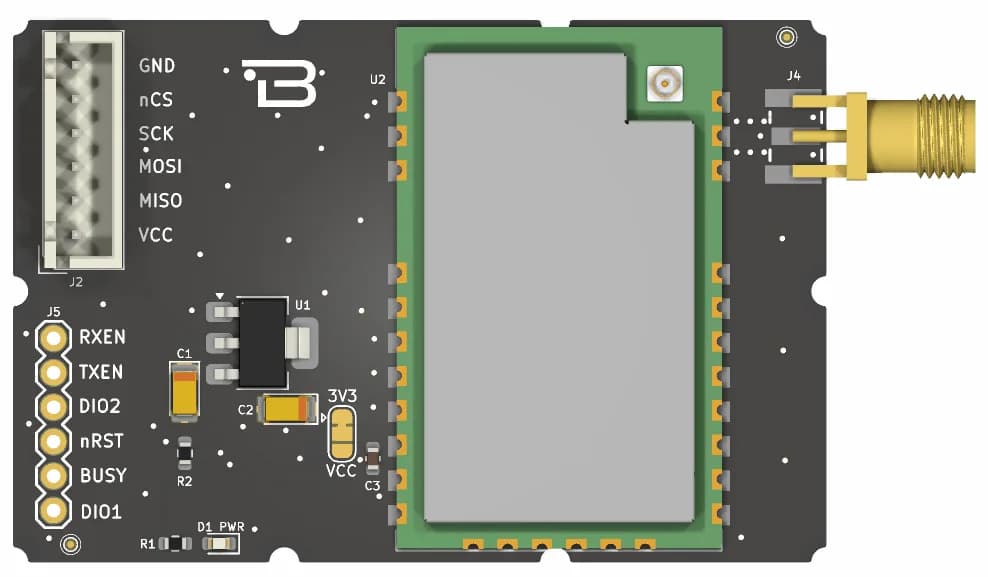
Communication between the host microcontroller and the module is provided through a standard SPI interface. All essential SPI and control signals—including nCS, SCK, MOSI, MISO, BUSY, nRST, DIO1, DIO2, RXEN and TXEN—are accessible through the onboard connectors and solder pads.
The board includes an SMA antenna connector, onboard voltage-regulation circuitry, supply-selection jumper, power indicator LED and local decoupling capacitors. These features simplify integration with embedded platforms such as Arduino, ESP32, STM32, Raspberry Pi and other microcontroller-based systems.
Note: Typical instantaneous transmit current is approximately 650 mA at 30 dBm. Allow approximately 700 mA when sizing the external power supply, with current headroom and minimal voltage drop; this is supply-sizing guidance, not a separate typical-current specification. Thin wires, weak USB supplies or low-current microcontroller regulator outputs should not be used to power the board at 30 dBm.
Typical Applications
- Long-range wireless sensor networks
- Industrial telemetry systems
- Smart agriculture and irrigation control
- Environmental monitoring stations
- Wireless alarm and security systems
- Remote equipment monitoring
- Smart metering and automatic meter-reading systems
- Building automation
- Remote pump and valve control
- Wireless data-acquisition systems
- Point-to-point LoRa communication
- Proprietary LoRa star networks
- IoT gateways and field nodes
- Rural communication systems
Key Features
- Ebyte E22-400M30S high-power LoRa transceiver module
- Based on the Semtech SX1268 RF transceiver
- Operating frequency range: 410–493 MHz
- Suitable for 433 MHz and 470 MHz applications
- Maximum RF output power: 30 dBm (approximately 1 W)
- Receiver sensitivity down to -150 dBm (typical at 0.3 kbps)
- Supports LoRa and GFSK modulation
- Air data rate from 0.018 kbps to 300 kbps
- Standard 4-wire SPI interface
- Accessible BUSY, nRST, DIO1 and DIO2 signals
- Dedicated RXEN and TXEN RF front-end control signals
- Onboard voltage-regulation and power-selection circuit
- Onboard power indicator LED
- External antenna connection through an SMA connector
- Designed for long-range sub-GHz wireless communication
- Suitable for industrial operating temperatures
Technical Specifications
- Board model
- Boardoza B-E22-400M30S-BRK R1.0
- RF module
- Ebyte E22-400M30S
- RF transceiver
- Semtech SX1268
- Operating Frequency
- 410–493 MHz
- Common operating bands
- 433 MHz / 470 MHz
- Maximum Output Power
- 30 dBm, approximately 1 W
- Receiver Sensitivity
- -150 dBm typical at 0.3 kbps
- Modulation
- LoRa, GFSK
- Air data rate
- 0.018–300 kbps
- Host communication interface
- SPI
- SPI signals
- nCS, SCK, MOSI, MISO
- Control signals
- BUSY, nRST, DIO1, DIO2
- RF switch control
- RXEN, TXEN
- Module supply range
- 2.5–5.5 V
- Typical interface logic level
- 3.3 V
- Typical transmit current
- Approximately 650 mA at 30 dBm (instantaneous TX current; allow approximately 700 mA when sizing the supply)
- Typical receive current
- Approximately 14 mA
- Typical sleep current
- Approximately 3 µA
- Operating Temperature
- -40 °C to +85 °C
- Antenna connection
- SMA connector
- Module RF impedance
- 50 Ω
- Board Dimensions
- 60mm x 40mm
Support
For technical questions, documentation and issue reports, use the GitHub repository or write to us directly.